Already have an SMSF loan? When it is worth reviewing or refinancing
A practical guide to checking your fund's current loan, asking for a better deal, and knowing when a switch genuinely pays off.
By Natalie Hawkes, Mortgage Broker 7 November 2026 8 minute read
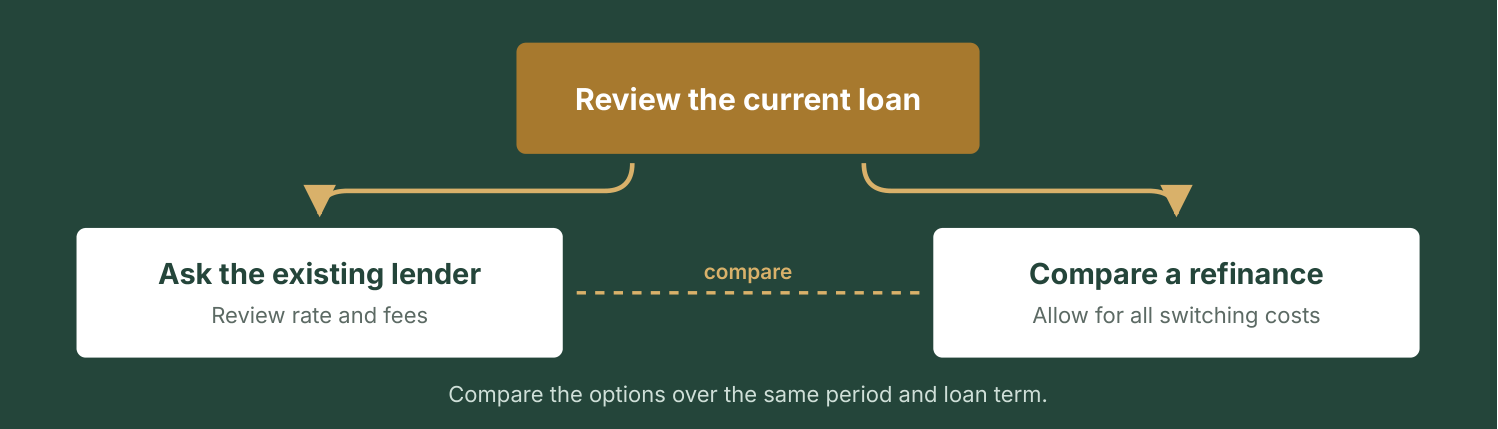
An SMSF property loan can sit in the background for years. A review helps you understand what you are paying and what is coming next. It does not mean you have to change lenders.
Sometimes the sensible first step is asking your current lender for better pricing. Other times, a refinance may be worth exploring. The decision should account for costs, the remaining loan term and the fund's ability to meet repayments.
A practical loan review checklist
Check the current rate
Use the latest statement or lender confirmation rather than the rate you remember from settlement.
Add up ongoing fees
Check annual, monthly and other continuing charges. Compare the full cost, not just the rate.
Find the fixed rate expiry date
Ask what rate applies afterwards and whether changing now would involve a break cost.
Find the interest only expiry date
Check when principal repayments begin, the remaining term and the likely repayment increase.
Look at when it was last reviewed
A review is useful when pricing, rent, contributions or the fund's circumstances change.
Ask about the lender's SMSF position
A lender no longer accepting new SMSF loans does not automatically mean existing borrowers must leave. Check its actual policy and support.
Rate negotiation and cost comparisons are practical review steps, not a promise of a discount or approval. Loan features and requirements vary between SMSF lenders.3,4
Repricing and refinancing are different
Repricing means asking the existing lender to improve the pricing on your current loan. It may involve less work and lower costs than moving. Ask whether any fee, product change or fresh contract is involved.
Refinancing involves a new loan contract. There may be discharge, application, valuation and legal costs, as well as fixed-rate break costs. Ask for the complete estimate before deciding.3
Even a small rate difference may justify a question, but there is no universal rate gap that makes switching worthwhile.
Compare genuinely available options for your fund and property, including any repricing offer from the current lender.
The lowest rate is not always the best move
Fictional example. Rates, fees and costs are assumptions only, not current market offers or lender quotes.
Lisa and David's SMSF owes $500,000 on a property loan. They are paying 8.00% interest plus a $400 annual loan fee. For this illustration only, the loan stays interest only and the balance stays at $500,000 throughout a two-year comparison.
Their current lender offers 7.75% with no repricing cost and the same annual fee. Another lender offers 7.50%, a $500 annual fee and $3,000 in total switching costs, paid from fund cash.
| OVER TWO YEARS | STAY AS IS | REPRICE | REFINANCE |
|---|---|---|---|
| Interest rate | 8.00% | 7.75% | 7.50% |
| Interest paid | $80,000 | $77,500 | $75,000 |
| Ongoing loan fees | $800 | $800 | $1,000 |
| Upfront switching cost | $0 | $0 | $3,000 |
| Total cost | $80,800 | $78,300 | $79,000 |
| Saving against staying as is | – | $2,500 | $1,800 |
Over two years, repricing is $700 cheaper than refinancing, despite the refinance having the lower interest rate. Both options improve on doing nothing in this example.
Compared with the repriced loan, the refinance saves $1,250 a year in interest but costs $100 more in annual fees. The net ongoing difference is $1,150 a year. Recovering the $3,000 switching cost would take about 31 months if those assumptions continued.
That break-even period matters. They need to consider how long the fund expects to keep the loan and property, whether rates may change and whether other loan features justify a move.
Simple constant-balance calculation before tax. No principal repayments, rate changes, compounding, offset balances or time value of money are modelled. Assumes all switching costs are included, no break cost applies, and fees and rates stay unchanged. This does not suggest an interest-only period will be approved or extended. Actual comparisons should use the fund's repayment schedule and quoted costs.
Always seek advice from your accountant or financial adviser about tax and costs.
What a refinance usually involves
Review the existing loan
Confirm the balance, remaining term, rate, fees, security and expiry dates. Be clear about what you want to improve.
Check lender fit
A new lender assesses the fund, property and repayment capacity. A good repayment history helps tell the story but does not guarantee approval.
Prepare documents
Requirements may include fund financials and tax returns, bank and loan statements, trust deeds, holding-trust documents, lease details and contribution information. The exact list depends on the application.
Check the legal structure
Your accountant reviews tax and fund matters within their scope; an appropriately authorised financial adviser addresses strategy suitability. Your solicitor checks legal documents and any proposed ownership changes. Do not replace trustees or transfer title without advice.2,4
Frequently asked questions
Q Can an older residential SMSF property loan be refinanced?
Potentially, yes. Earlier borrowings have protection under the August 2026 changes. The transaction still needs to satisfy the applicable LRBA rules and the new lender's policy. The property does not automatically need to become business real property just because an eligible earlier borrowing is refinanced.1,5
Q Should I ask my current lender for a better rate first?
Often that is a useful starting point. Compare its response with the full cost of moving. A discount is not guaranteed, and the existing product may still have limitations that matter to the fund.3
Q Can I release equity for another property or other expenses?
Generally, no. LRBA refinancing is not general cash-out lending. The ATO describes replacement borrowing used to extinguish the previous borrowing and meet associated costs. Additional borrowing or a different asset needs separate specialist advice.2
Q Will we need a new holding trust?
Not automatically. The existing structure and the proposed lender's requirements need checking. A trust or title change can have legal and tax consequences. Have your solicitor review it before any change is made.2
Q What if our lender has stopped accepting new SMSF loans?
Check what that means for existing borrowers, repricing and servicing. It does not by itself tell you that your loan must move or that another lender will approve a refinance.
Q How long does a refinance take?
Timing depends on the lender, valuation, documents, legal work and discharge process. Start before a fixed or interest-only expiry rather than relying on a guaranteed settlement date.
General information only. This article does not consider your objectives, financial situation or needs and is not personal financial, tax or legal advice. Obtain advice from appropriately qualified professionals before changing an SMSF borrowing or ownership structure. Rules and lender policies can change. Savings and approval are not guaranteed. Moneysmart's switching guidance explains general comparison principles; SMSF lending has additional rules and lender requirements. Natalie Hawkes is Credit Representative 479789 of Australian Finance Group Ltd, Australian Credit Licence 389087.
SOURCES · CHECKED 7 NOVEMBER 2026
1. Treasury Laws Amendment (Tax Reform No. 1) Act 2026, Sch 5
2. ATO: SMSFs and limited recourse borrowing arrangements
3. ASIC Moneysmart: Switching home loans
4. ASIC Moneysmart: SMSFs and property
5. ATO: Changes to LRBAs for property from 10 August